Still searching for a new farm property, with very little luck there. It always seems like we are close to a deal, and then something happens. This last deal just seemed to evaporate. The land owner seemed to be on board, and we seemed close to closing the deal, and then nothing, no returns of our calls, nothing. So I am looking again, with little success. I am trying to get EcoContracting running, but that too, seems a little retarded. I can't get to the sites to make bids, and I don't have the capital to float the cost of materials. The job I did for ServiceComUSA seems to have gone dead, so I will have to try to force them to pay me for the work I have done. This is why I required them to pay for the materials on the job, because I sent in my quote, and they have ceased to contact me. Not some type of refusal or even counter offer, just nothing. I hope to get this other work from Easy to Own Homes, but I don't know about them either. The lack of capital is hurting me, but I think if they agree to the bid with a 50% deposit, I can get a loan for the materials and operating cost, so I can move forward on that.
The rest is going as it goes, I don't get out to the farm nearly early enough, and the animals are still just getting by. We are getting no eggs from our chickens, but I am not certain of why. I need to build so many things, but for that I need to build a building, but for that I need a piece of land, and for that I need to work to get the money, and for that I need to spend money, so that's where I am at. I have got to go, maybe I will try to post again later.
Showing posts with label Farming. Show all posts
Showing posts with label Farming. Show all posts
Saturday, September 26, 2009

Saturday, September 12, 2009
DDFJ_09-12-2009
Doud Dairy Farm Journal
Saturday, September 12, 2009
Well we didn't move the fence again today, but we did get four (4) eggs. So the production reds are at least producing. I got about 2/3 the shelter built, and will finish it today. So that's the scoop for the day, at least as far as the farm is concerned. At least the animals got out for a while yesterday, so they could eat well, and swim and all that, although getting the chickens back in was a bit of a chore. I still have the nest to build, and roost to install in the shelter, and other such modifications. There doesn't seem to be enough branches to cut, but I have only just begun I guess. We really need to move the animals to our new land, but we are still waiting on the final agreement to be drawn up. I hope it don't take to much longer, because winter is coming, and I am pretty certain it is going to be a rather cold and nasty one this year.
The truth is Spring is coming soon too. We are not even ready for that either. We don't have a planting schedule, or a place to start plants. No green house this year, so we will have to start plants in the house and barn, and build beds where we can set them in high tunnels to hopefully get a jump on the season, because we don't have a lot of season. We will however be able to plant lots of greens as we will have great amounts of shade so we will be able to grow greens quite late if we set them in strategic places. Our market crops are a big part of our income for next year, so we will have to figure out how to obtain the seed and get things going early. I want lots of tomatoes set. Mostly heirloom Brandywines, but we should have lots of plum type tomatoes too, because they are the blood of sauces and other tomato based products. I need to ensure that we will have the buyers for the Brandywines, so we can be certain that if we set them, they will be valuable. Next Spring we will build a green house, and grow Brandywines early and late, as we will heat part of the green house to create a sudo hot house. I want to produce about three cases a week for our wholesale customers, plus some for the market. We will also have to produce greens, mostly romaine lettuce and custom greens for our wholesale customers, but we should be able to provide these without much trouble. I will get commitments from our wholesale customers in the form of deposits which should cover our seed cost. We most likely will not have organic status for three years, so we will have to get by on lower cost, unless we can get Eddy to agree to sign an affidavit that no chemicals have been used on the property for at least the last five years.
We also won't have a proper parlor in the barn as we will building a basic New England style barn, with just tie stalls for milking using a swing system with 2” pipeline to a bulk tank in the milk house addition.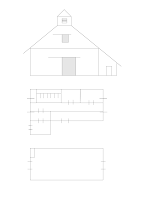 The barn will be 20'x40' with a 10'x12' milk house addition. Although this diagram doesn't show it very well it has a six tie stall parlor, a storage room and two box stalls. It also includes a free stall and a hay loft. There are four of the cubicles on the roof that act as vents, and will include exhaust fans that can be opened or closed to control venting of the barn. This will not be the final barn, and the installation of the parlor is temporary, in that we will be building a much bigger free stall barn which will have a ATO ARM herringbone style parlor and multi-tank milk house connected by pipeline to the creamery. This barn will then be used for heifers and other animals as well as hay storage. We will also build a horse and machinery barn which will be attached to an indoor paddock which will double as a show ring area. The new barn will be a New England style barn as well in keeping with the current look of the first barn. The horse barn will also be a NE style barn, with a round indoor paddock addition. The green houses will also reflect this same NE style to maintain the basic look of the farm. I had considered the gamble roof style, but the complexity and cost of the trusses would make it difficult to build at least at first, so we will continue to use the NE style just to maintain the look of the farm.
Well that's the plan anyways. I will maybe go into the house/cabin later. I still haven't decided if I will build a salt box style, or cape cod style. Either way, we may build a small cabin >1000' to begin with, and then later once we have purchased the property build a more substantial house. We will also be building dedicated buildings, such as a mill, a soap factory, a forage/kiln/bakery/cannery and some other special buildings which will be used for special purposes. Well that's it for now, I have work to do and daylight is burning.
Peace.
Saturday, September 12, 2009
Well we didn't move the fence again today, but we did get four (4) eggs. So the production reds are at least producing. I got about 2/3 the shelter built, and will finish it today. So that's the scoop for the day, at least as far as the farm is concerned. At least the animals got out for a while yesterday, so they could eat well, and swim and all that, although getting the chickens back in was a bit of a chore. I still have the nest to build, and roost to install in the shelter, and other such modifications. There doesn't seem to be enough branches to cut, but I have only just begun I guess. We really need to move the animals to our new land, but we are still waiting on the final agreement to be drawn up. I hope it don't take to much longer, because winter is coming, and I am pretty certain it is going to be a rather cold and nasty one this year.
The truth is Spring is coming soon too. We are not even ready for that either. We don't have a planting schedule, or a place to start plants. No green house this year, so we will have to start plants in the house and barn, and build beds where we can set them in high tunnels to hopefully get a jump on the season, because we don't have a lot of season. We will however be able to plant lots of greens as we will have great amounts of shade so we will be able to grow greens quite late if we set them in strategic places. Our market crops are a big part of our income for next year, so we will have to figure out how to obtain the seed and get things going early. I want lots of tomatoes set. Mostly heirloom Brandywines, but we should have lots of plum type tomatoes too, because they are the blood of sauces and other tomato based products. I need to ensure that we will have the buyers for the Brandywines, so we can be certain that if we set them, they will be valuable. Next Spring we will build a green house, and grow Brandywines early and late, as we will heat part of the green house to create a sudo hot house. I want to produce about three cases a week for our wholesale customers, plus some for the market. We will also have to produce greens, mostly romaine lettuce and custom greens for our wholesale customers, but we should be able to provide these without much trouble. I will get commitments from our wholesale customers in the form of deposits which should cover our seed cost. We most likely will not have organic status for three years, so we will have to get by on lower cost, unless we can get Eddy to agree to sign an affidavit that no chemicals have been used on the property for at least the last five years.
We also won't have a proper parlor in the barn as we will building a basic New England style barn, with just tie stalls for milking using a swing system with 2” pipeline to a bulk tank in the milk house addition.
 The barn will be 20'x40' with a 10'x12' milk house addition. Although this diagram doesn't show it very well it has a six tie stall parlor, a storage room and two box stalls. It also includes a free stall and a hay loft. There are four of the cubicles on the roof that act as vents, and will include exhaust fans that can be opened or closed to control venting of the barn. This will not be the final barn, and the installation of the parlor is temporary, in that we will be building a much bigger free stall barn which will have a ATO ARM herringbone style parlor and multi-tank milk house connected by pipeline to the creamery. This barn will then be used for heifers and other animals as well as hay storage. We will also build a horse and machinery barn which will be attached to an indoor paddock which will double as a show ring area. The new barn will be a New England style barn as well in keeping with the current look of the first barn. The horse barn will also be a NE style barn, with a round indoor paddock addition. The green houses will also reflect this same NE style to maintain the basic look of the farm. I had considered the gamble roof style, but the complexity and cost of the trusses would make it difficult to build at least at first, so we will continue to use the NE style just to maintain the look of the farm.
Well that's the plan anyways. I will maybe go into the house/cabin later. I still haven't decided if I will build a salt box style, or cape cod style. Either way, we may build a small cabin >1000' to begin with, and then later once we have purchased the property build a more substantial house. We will also be building dedicated buildings, such as a mill, a soap factory, a forage/kiln/bakery/cannery and some other special buildings which will be used for special purposes. Well that's it for now, I have work to do and daylight is burning.
Peace.
Monday, September 07, 2009
Away from the Farm
We had to get away from the farm we used to share with another sort of farmer. Well he wasn't and isn't a farmer at all, not even a little bit. He is a biker who thought he would like to be a farmer, but he isn't one at all. I could go into great detail, but I won't right now, we just had to leave that place, and the animals show it. Before our goats were stunted in growth and starving, even though we provided all the grain for his entire farm (cows, chickens, calves, and whatever else) our goats were still starving. They didn't get their grain although we had to buy it every week, so it must have been used or eaten by something. We don't know, but what I can tell you is that since our animals have been off that guys farm they have flourished and grown by leaps and bounds. We lost most of our ducks and chickens on his farm, we have lost none as of lately, and they have begun to grow much faster and fatter. We didn't have proper fences on his farm, and the goats were everywhere, now they stay in their fence, as small as it is, and we move it to keep them with fresh forage. We did lose one goat to my own stupidity, but had this guy not gone ballistic for at least another two days we would have not lost our goat, or had to scramble and put our finances in the spin they are in.
I will rant more about the non-farmers I find and have found along the way at some other time. Things that make me go hmmmm.
I will rant more about the non-farmers I find and have found along the way at some other time. Things that make me go hmmmm.
Doud Dairy Farm Journal

Doud Dairy Farm Journal
Sunday, September 06, 2009
I missed a couple of days, with all that has been going on. I am not sure where I left off, but I think I didn't write entries for the fifth and the fourth, and the third is on another computer, waiting to be loaded to Frontier Spirit blog. So anyway, today we got a late start because I had a couple of things to do at the house, and we had to pick up Justin, my step-son and Arleta's youngest son. We went out to look at the property, and it is basically just woods and a couple of trails running through it. I am ready to provide Eddy with an offer. We will offer him 450.00 a month for 6 months, with an option to purchase at the end of the lease terms. We will then discuss the building thing, as we will offer to build a small barn and a cabin on the property, as well as dig a well. We will use this as equity if we buy the property in the spring, but if we do end the contract in spring we will leave the buildings, thereby providing him with more value for his property. I talked a minute with the next door neighbor, and he says they have 88 acres, so there may be potential for purchasing more property in the future. This would be good to discuss with Eddy as well. In lieu of a security deposit we will dig the well and put in a septic system, as well as build the buildings, which will benefit him if we leave the property. If we do decide to purchase the property in the spring, we will offer him $1,000.00 an acre or $44,000.00 plus what we have paid him for the rent.
Well now we have to see if he accepts the deal we present. Or if he comes back with a counter offer, we will have to consider that as well. I want to talk with him about the additional acres, to see if we can include that in the spring purchase option.
As far as the animals are concerned well, last week I couldn't get a chicken at all and this week we are in the process of buying chickens from everywhere. We bought 6 last night (RIR) from Williamstown, and we will be buying another 7 or 8 today from Homer. Now we will have 16 RIR chickens, and if we can get the 11 Orpingtons we will have the 20+ chickens we need to winter over with.
All the other animals (Goats, Ducks) are doing well, and getting fat on the land.
I need a truck, as there is just to much that I could do with a truck that would be helpful that I can not do with the Kia. Although the Kia is cute and it really is a nice vehicle, and all that, it will not accommodate the needs that a truck will. That or I need to get the Kia fixed, and a tow hitch attached so we can pull a trailer. I like the trailer idea, because a trailer is more versatile than just a truck, but it may be easier to get a truck than fix the Kia at this point.
That's all for now, more tomorrow when I get everything in its place.
Peace.
Thursday, October 30, 2008
"How a city was built, starting with a hobby: Baker Creek--a seed house that is changing the course of history"
Goss, Jeffery, Jr. 2008 How a city was built, starting with a hobby: Baker Creek--a seed house that is changing the course of history The Free Library (January, 1), http://www.thefreelibrary.com/How a city was built, starting with a hobby: Baker Creek--a seed...-a0172830071 (accessed October 30 2008)
This article describes a operation that was started by a young person who felt the need for a change. This is how a need can be turned into a business that can be successful. I guess what can be said about it is that he started on a farm, so it would be more difficult if you were to attempt to begin such an operation with out having a family farm to begin from, but it should be possible.
This will be cited in our business plan.
This article describes a operation that was started by a young person who felt the need for a change. This is how a need can be turned into a business that can be successful. I guess what can be said about it is that he started on a farm, so it would be more difficult if you were to attempt to begin such an operation with out having a family farm to begin from, but it should be possible.
This will be cited in our business plan.
Small Farms Cultivate Way of Life, and Profit
NY Times article on profits being made by small part time farmers. A trend that appears to be developing in the suburban landscape. People are trying to farm even on small 3+/- acres and many are successful at turning a profit, but is it really farming? This is yet to be discovered trend that should be investigated further. It does however demonstrate that profit can be found even in this small scale, and that can be applied to a larger more diversified farming operation.
Friday, September 19, 2008
New Plan B
“The Farm”
Starting over, okay, in an old home town. We know the where, we need to discover the how. This is a document to discover how we are going to build, operate, and finance “the farm”.
Where is in Oswego County. Exactly where in Oswego County is a little more difficult to determine as yet, but preliminary searches has identified at least a couple of potential opportunities; however further investigation will be necessary to completely vett out the short list of properties. Some indicators are, that it is East of Mexico, West of Parish, and South of Central Square, although this is not precise enough to determine that it be exactly in an area, or that it is not in any of the particular municipalities, but that our belief is that our opportunity is most likely in an area near or between the Hamlet of Hastings, and the Villages of Mexico and Parish.
The why may be easier to determine. “The Farm” is the base of all our operations, including our agricultural ones. First “the farm” is exactly what it is, a farm. A diversified agricultural operation with dairy and meat purposes, as well as horticultural and grain purposes. The basis behind this is a sustainable operation that supports itself, and its community through full development of all the processes that are needed to provide the basic products that are the result of the operations. For example; grain such as wheat is useless to most animals including humans until processed. On “the farm” we will build a grist mill, to process the wheat and other grains into usable products such as groats and flours. Further we will also build a bakery that will process the flours into baked goods (mostly breads) that then will be used on “the farm” and also sold through our marketing programs. We will also provide a percentage of our production to help support our food programs for homeless and people with low to no incomes (see food bank program). Grains will not be processed for use by the animals as such, as there is very little value in the processing of grains for animals, with the exception of post processed materials, such as shaft and other hard materials which will be processed further for cellulose values, and then the final use will be as filler for animal supplements (see animal feed stock programs). This same processing program is followed throughout the outputs including the building of a dairy and creamery for the processing of raw milk products. In addition we will be building cheese caves, for the processing of dairy products. To facilitate all this building we will build several support operation buildings, such as a large back draft kiln, a foundry and forge, various other shops such as a cabinet shop, a mill wright shop, a blacksmith shop, and the list is continued (see support operations). The additional benefit to this design and building is that we will be providing work for more people in the community that will work the various operations that are on “the farm”. The secondary benefit to this plan is that we will also be preserving talents and arts that are seldom used in current technological society. We will also be providing many educational opportunities to the community to see the operations, to learn from the operations, and to duplicate the same operations in their communities. We will also be providing a tourist attraction, including accommodations and hospitality, appropriate to the programs. Additional support systems include development of a community school, a community health and wellness center, and a knowledge center for independent study of the greater knowledges. We will also be developing energy programs some of which will be traditional and some of which are experimental; such as wind generation and water powered mechanical systems, but also hydrogen fuel cells, and other more experimental solar technologies (see energy plan). This is a multi year plan, with many programs being conducted through a process of appropriate development from one technology to the next. Our first program will be to build the draft kiln and forge to facilitate the processing of local materials into building materials for the other programs. We will also build a wood mill, and supporting shops to enable us to build other structures using those processed materials. We will then build housing for animals, including humans, allowing us to then begin to allocate the animals (see animal matrix) that will then provide the products that will be further processed as we continue to build other programs. We will be continuing the building programs for the first three years as we continue to build the initial functional programs of “the farm”.
The second easy question is when, well sort of. If the question of when is when will we get started, well that is now, or at least as soon as possible. We will work with the various organizations to try to get the operation started and through basic functioning by Spring of 2009. The basic functioning will require certain tools and equipment and focus to enable us to begin with the basic functional constructions while developing the basic living structures that will also be needed temporarily to create a workable foundation. We have nothing to start with, which in some ways is considered a disadvantage; however it also is an advantage. How is it an advantage? On the basis that we can structure our entire operation to be sustainable, and “green” (see “green” initiatives). One particular area where this is evident is in equipment, where we will utilize alternative fuels such as bio-diesel, but we will also utilize electrical equipment, with the energy coming from our initial energy programs. This of course means that we will need to build a bio-diesel plant very early in the process. We will need a skid steer tractor to begin building. We will need to look for one that utilizes diesel to ensure that we can utilize renewable bio-diesel fuels. This will also be the main piece of equipment that will be used on “the farm” throughout its operations. Many field operations will be performed through horse drawn processes, although, some will be performed with mechanical machines, some of which will be electric. So the when is more determined by the completion of this document, the working with various organizations (such as Cooperative Extension and Farmlink), and obtaining the seed capital to begin the process of building after we have solved the where, why, and how problems.
Who is the next question. At this time the program is headed by myself and my wife. We feel the need to begin this program and direct it through its first few years, while we are certain that others will be involved in different capacities as we continue to build “the farm”. I am currently unemployed at this time, so I am collecting unemployment while I search for a job in the area where we are planning on locating. I am also a self employed general contractor, although because we are currently not located where we are planning on being located, I will have to re-build the business once we are located in the area we plan on being located. I am also seeking to obtain my insurance certificate so that I can offer people and businesses in my community insurance products. This will be in addition to all that we are planning on doing with “the farm” and the various other organizations that we are planning or will be involved with. My wife Arleta, will be obtaining her degree in Accounting so that she will be able to offer that service to people in our community. She is also obtaining her tax preparer certificate so that she can offer that service while she completes her degree. She will also be making products for sale, with some proceeds going to our not-for-profit organization. She will be making candles and jewelery which we will sell on-line and in various boutiques in the area. She will also be working to building her soap and personal care products company, as we are able to fund that program as well. We will be selling our agricultural products in various stages of production, continuing to build the diversity of production systems to better serve our community (see farm production).
Lastly is how. This is where I have the greatest difficulty. I have nothing but my knowledge to bring to this. Well that and my determination and physical capability to get the job done. I am not a great sales person, so selling the plan to investors will be difficult for me, but necessary. We will need to find not just seed capital to allocate land and basic equipment, but also operations capital, growth capital, and of course capital for the purchase of animals, seed stocks (see seed banks), and tools and equipment for operations of “the farm”. I do not know how much this will cost, as this is a work in progress. I will work to determine at least how much we will need to seed “the farm”, but there will need to be more cost figures determined. We will need to estimate our potential incomes from all the various steams. Consider that a portion of the production is provided directly to needs organizations through our not-for-profit organization. This is not loss, but overage that will be absorbed by the incomes and funding derived by the members of such programs as the Community Supported Agriculture, and home delivery programs (see income stream plans). We will also market our products in local markets, through local farmers markets, local grocery stores, local restaurants, and local schools. We will also be developing hospitality programs which will include an on farm market, an on farm restaurant, and other such processed food programs. We will be working with local farms to assist us in diversifying our product matrix, and to enhance the local agricultural network. These are but a few examples of our marketing programs, and will be included in our income matrix. I will need assistance in planning this part of the plan as this is not an area where I am very strong.
This is all I got for now, more will be done later, but for now, I must pack our belongings as we have lost our house and have to be out in the next six days. We have by the grace of great friends and relatives been able to afford to make the move from Geneva, NY to Oswego, NY (or actually North Syracuse, NY for the moment) and secure our belongings until we can complete the planning process at least to the point of obtaining the initial seed capital.
This is published on my blog so that anyone that wishes to comment may have that opportunity.
Starting over, okay, in an old home town. We know the where, we need to discover the how. This is a document to discover how we are going to build, operate, and finance “the farm”.
Where is in Oswego County. Exactly where in Oswego County is a little more difficult to determine as yet, but preliminary searches has identified at least a couple of potential opportunities; however further investigation will be necessary to completely vett out the short list of properties. Some indicators are, that it is East of Mexico, West of Parish, and South of Central Square, although this is not precise enough to determine that it be exactly in an area, or that it is not in any of the particular municipalities, but that our belief is that our opportunity is most likely in an area near or between the Hamlet of Hastings, and the Villages of Mexico and Parish.
The why may be easier to determine. “The Farm” is the base of all our operations, including our agricultural ones. First “the farm” is exactly what it is, a farm. A diversified agricultural operation with dairy and meat purposes, as well as horticultural and grain purposes. The basis behind this is a sustainable operation that supports itself, and its community through full development of all the processes that are needed to provide the basic products that are the result of the operations. For example; grain such as wheat is useless to most animals including humans until processed. On “the farm” we will build a grist mill, to process the wheat and other grains into usable products such as groats and flours. Further we will also build a bakery that will process the flours into baked goods (mostly breads) that then will be used on “the farm” and also sold through our marketing programs. We will also provide a percentage of our production to help support our food programs for homeless and people with low to no incomes (see food bank program). Grains will not be processed for use by the animals as such, as there is very little value in the processing of grains for animals, with the exception of post processed materials, such as shaft and other hard materials which will be processed further for cellulose values, and then the final use will be as filler for animal supplements (see animal feed stock programs). This same processing program is followed throughout the outputs including the building of a dairy and creamery for the processing of raw milk products. In addition we will be building cheese caves, for the processing of dairy products. To facilitate all this building we will build several support operation buildings, such as a large back draft kiln, a foundry and forge, various other shops such as a cabinet shop, a mill wright shop, a blacksmith shop, and the list is continued (see support operations). The additional benefit to this design and building is that we will be providing work for more people in the community that will work the various operations that are on “the farm”. The secondary benefit to this plan is that we will also be preserving talents and arts that are seldom used in current technological society. We will also be providing many educational opportunities to the community to see the operations, to learn from the operations, and to duplicate the same operations in their communities. We will also be providing a tourist attraction, including accommodations and hospitality, appropriate to the programs. Additional support systems include development of a community school, a community health and wellness center, and a knowledge center for independent study of the greater knowledges. We will also be developing energy programs some of which will be traditional and some of which are experimental; such as wind generation and water powered mechanical systems, but also hydrogen fuel cells, and other more experimental solar technologies (see energy plan). This is a multi year plan, with many programs being conducted through a process of appropriate development from one technology to the next. Our first program will be to build the draft kiln and forge to facilitate the processing of local materials into building materials for the other programs. We will also build a wood mill, and supporting shops to enable us to build other structures using those processed materials. We will then build housing for animals, including humans, allowing us to then begin to allocate the animals (see animal matrix) that will then provide the products that will be further processed as we continue to build other programs. We will be continuing the building programs for the first three years as we continue to build the initial functional programs of “the farm”.
The second easy question is when, well sort of. If the question of when is when will we get started, well that is now, or at least as soon as possible. We will work with the various organizations to try to get the operation started and through basic functioning by Spring of 2009. The basic functioning will require certain tools and equipment and focus to enable us to begin with the basic functional constructions while developing the basic living structures that will also be needed temporarily to create a workable foundation. We have nothing to start with, which in some ways is considered a disadvantage; however it also is an advantage. How is it an advantage? On the basis that we can structure our entire operation to be sustainable, and “green” (see “green” initiatives). One particular area where this is evident is in equipment, where we will utilize alternative fuels such as bio-diesel, but we will also utilize electrical equipment, with the energy coming from our initial energy programs. This of course means that we will need to build a bio-diesel plant very early in the process. We will need a skid steer tractor to begin building. We will need to look for one that utilizes diesel to ensure that we can utilize renewable bio-diesel fuels. This will also be the main piece of equipment that will be used on “the farm” throughout its operations. Many field operations will be performed through horse drawn processes, although, some will be performed with mechanical machines, some of which will be electric. So the when is more determined by the completion of this document, the working with various organizations (such as Cooperative Extension and Farmlink), and obtaining the seed capital to begin the process of building after we have solved the where, why, and how problems.
Who is the next question. At this time the program is headed by myself and my wife. We feel the need to begin this program and direct it through its first few years, while we are certain that others will be involved in different capacities as we continue to build “the farm”. I am currently unemployed at this time, so I am collecting unemployment while I search for a job in the area where we are planning on locating. I am also a self employed general contractor, although because we are currently not located where we are planning on being located, I will have to re-build the business once we are located in the area we plan on being located. I am also seeking to obtain my insurance certificate so that I can offer people and businesses in my community insurance products. This will be in addition to all that we are planning on doing with “the farm” and the various other organizations that we are planning or will be involved with. My wife Arleta, will be obtaining her degree in Accounting so that she will be able to offer that service to people in our community. She is also obtaining her tax preparer certificate so that she can offer that service while she completes her degree. She will also be making products for sale, with some proceeds going to our not-for-profit organization. She will be making candles and jewelery which we will sell on-line and in various boutiques in the area. She will also be working to building her soap and personal care products company, as we are able to fund that program as well. We will be selling our agricultural products in various stages of production, continuing to build the diversity of production systems to better serve our community (see farm production).
Lastly is how. This is where I have the greatest difficulty. I have nothing but my knowledge to bring to this. Well that and my determination and physical capability to get the job done. I am not a great sales person, so selling the plan to investors will be difficult for me, but necessary. We will need to find not just seed capital to allocate land and basic equipment, but also operations capital, growth capital, and of course capital for the purchase of animals, seed stocks (see seed banks), and tools and equipment for operations of “the farm”. I do not know how much this will cost, as this is a work in progress. I will work to determine at least how much we will need to seed “the farm”, but there will need to be more cost figures determined. We will need to estimate our potential incomes from all the various steams. Consider that a portion of the production is provided directly to needs organizations through our not-for-profit organization. This is not loss, but overage that will be absorbed by the incomes and funding derived by the members of such programs as the Community Supported Agriculture, and home delivery programs (see income stream plans). We will also market our products in local markets, through local farmers markets, local grocery stores, local restaurants, and local schools. We will also be developing hospitality programs which will include an on farm market, an on farm restaurant, and other such processed food programs. We will be working with local farms to assist us in diversifying our product matrix, and to enhance the local agricultural network. These are but a few examples of our marketing programs, and will be included in our income matrix. I will need assistance in planning this part of the plan as this is not an area where I am very strong.
This is all I got for now, more will be done later, but for now, I must pack our belongings as we have lost our house and have to be out in the next six days. We have by the grace of great friends and relatives been able to afford to make the move from Geneva, NY to Oswego, NY (or actually North Syracuse, NY for the moment) and secure our belongings until we can complete the planning process at least to the point of obtaining the initial seed capital.
This is published on my blog so that anyone that wishes to comment may have that opportunity.
Thursday, September 04, 2008
Now and Future Plans
Our plans are to build a horticultural operation, based on three main green houses and perennial gardens. This is based on our current potential property. We will build two 20x40x20 tunnels (tube houses) and one 20x60x20 tunnel that will create a L shaped green house complex. This complex will also have a fence around it, allowing our chickens to be used to keep the complex clean. In the green houses we will grow market crops specifically for target markets. We are currently working with individual organizations to determine what they are seeking and this will determine what we grow. All the operations will be certified organic. We will be installing a water treatment plant that includes filtering systems designed by myself. It will include the OWR by Nordic Living Water. It will also include a gray water system that will provide continuous water to the green houses through a passive filtering system and drip and mist system.
We will build an electronic monitoring system based in open source technology and utilizing hand held computer for local data capture and wireless network for instant transfer of captured data of both active and passive monitoring systems. This will all be held in a database that will be used to analyze the data and then provided to our customers in near real time, so that they will have up to date information on the health and progress of their crops. This will also allow us to provide data for educational purposes, and to educational institutions, specifically our educational partners, including Cornell University and Cornell's Cooperative Extension. W are currently working with Cornell's Cooperative Extension to put together the financial plan needed to begin operations.
We will also feature extensive perennial gardens with many herbs and other plants for seasoning and medicinal purposes. The gardens will also be ornamental and based in permacultural practices, providing for aesthetic values. We will also be featuring local connections to local educational institutions to provide educational opportunities to elementary through high school students about organic agricultural.
We are also talking with the farmer that owns the land surrounding our property to arrange for some type of expansion of our current property either through a long term lease or through a purchase plan that will allow us to expand our operations into livestock, dairy and other operations.
We will also be considering housing in the future, to provide some type of housing provision for individuals and couples who will assist us in the operations of our organization.
We currently are in contact with several retailers, and restaurants in Rochester and Seneca Falls, NY to provide them with green house products. We will also provide products direct on the farm through a farm stand. We are also considering local farmers markets, however we have not investigated that avenue as thoroughly yet to consider it a viable outlet at this time.
More information is available about this project by contacting the principal James E. Doud at this site, through the comment system. We can not provide an email address here, as the level of spam that will be generated does not allow us to do this at this time. We are working on this, and will be putting a website up soon, that will allow people to contact us directly.
We are also interested in investment partnerships, in either finance or in knowledge, and they can contact us through the website once it is up and running. The web address will be posted here when it is completed and operating.
We will build an electronic monitoring system based in open source technology and utilizing hand held computer for local data capture and wireless network for instant transfer of captured data of both active and passive monitoring systems. This will all be held in a database that will be used to analyze the data and then provided to our customers in near real time, so that they will have up to date information on the health and progress of their crops. This will also allow us to provide data for educational purposes, and to educational institutions, specifically our educational partners, including Cornell University and Cornell's Cooperative Extension. W are currently working with Cornell's Cooperative Extension to put together the financial plan needed to begin operations.
We will also feature extensive perennial gardens with many herbs and other plants for seasoning and medicinal purposes. The gardens will also be ornamental and based in permacultural practices, providing for aesthetic values. We will also be featuring local connections to local educational institutions to provide educational opportunities to elementary through high school students about organic agricultural.
We are also talking with the farmer that owns the land surrounding our property to arrange for some type of expansion of our current property either through a long term lease or through a purchase plan that will allow us to expand our operations into livestock, dairy and other operations.
We will also be considering housing in the future, to provide some type of housing provision for individuals and couples who will assist us in the operations of our organization.
We currently are in contact with several retailers, and restaurants in Rochester and Seneca Falls, NY to provide them with green house products. We will also provide products direct on the farm through a farm stand. We are also considering local farmers markets, however we have not investigated that avenue as thoroughly yet to consider it a viable outlet at this time.
More information is available about this project by contacting the principal James E. Doud at this site, through the comment system. We can not provide an email address here, as the level of spam that will be generated does not allow us to do this at this time. We are working on this, and will be putting a website up soon, that will allow people to contact us directly.
We are also interested in investment partnerships, in either finance or in knowledge, and they can contact us through the website once it is up and running. The web address will be posted here when it is completed and operating.
Sunday, March 11, 2007
Farm Book v1.0
The Farm Book v1
Every year is time of harvest, be it spring or fall. In spring the harvest is in the animal kingdom mostly, although many plants come to fruit then also. However we should right now discuss the spring harvest of animals.
In temperate zones, that is where winter lets fly with cold and snow, the seasons are generally more pronounced, In the modern industrial world we have harnessed the ability to effect the climate, although not entirely on purpose, and well away from the balance, However it still snows, and gets moderately cold, so there is a dying if it is rather short and broken by periods of rain and thaw. Either way, the rams would do well their work, had they been let aside the flocks in the fall (down time), and by early spring, lambs would be the first harvest. The first lamb to be harvested is unlucky if it is a ram (*boy), not in the sense of luck for us, but for it, because it will be fettered first, nearly from the nipple.
The clan farm would pasture 20-40 sheep, being they provide multiples of product, including early milk. One ram per 10 sheep (ewes) , will be tolerated, ,more so if there are more than three Shepard. The heard is thinned in the fall, but excess rams (in the lambs) will be sold for their weight at 6 months. The sheep will produce one or two lambs, and this is based in abundance. An abundance of food in fall will produce higher incidences of twining in spring. If 20 sheep produce 30 lambs, every third will be fettered, the rest will be culled, the top to flocked, the remaining ten to be sold at hoof, the way they stand, On this of the remaining ten, two may be sold as parts, allowing their trails to be sacrifices to the dogs for their contribution.
Just a brief bit abut dog and humans that use them. A dog is a tool, if it fails it must be fixed, if it can not be fixed it must be eliminated. Any human who relies on dogs then must breed them, and therefore cull them. Dogs must also be traded as any animal,. to keep the stock alive. Any dog that is not performing as is it's nature will be made part of the stew that the Shepard dine upon. Any Shepard that feels not should not be a Shepard. The trails of this dogs must be fed to the rest of the dogs, in full view of the dogs remaining, to ensure that they know their fate is at the hands of the Shepard if they fail to perform as they are breed. In addition the coat will be tanned and used to provide the cloak for the whelping mothers, as a sign of respect for her dedication.
The sheep are the first to produce, followed quickly by the poultry,m kids and kittens. The spring is very busy, but not hurried, for to hurry is to waste energy on waste. Soon after the kids the swine will give birth and then the cattle, followed last by the mares. In this time if Alpaca are kept, they will drop with the swine, or right soon after as would any late goat or sheep. The cattle will drop late spring, but save the fall cattle (half the heard is dry, while half is wet). The same is for the goat and sheep (alpaca also), while the horse, swine and poultry (as rabbits are 3 tines) are once in spring and dry for the reminder, as their young are either many in their a commodity. With horse, the breeding is staggered, as a mare is useless for work while breed and 3 months thereafter, she must also rest one year between colts to produce wealth of any kind.
For a moment let me discuss the issues of cats. Cats are a necessary evil, so to speak. They are consumers of resources, and their purpose is best when unknown. However their lack of use is immediately known. When vermin (mice or rats or other parasitic rodent) invade the barn or home, the cats must be culled. They will suffer disease on occasion, when poverty strikes them, they must be culled. Otherwise they are ranged, with access to nearly any place, and no knowledge of them is always best. They are fed only the raw scraps and raw milk, leaving them to feed on the rodents and whatever swallows or crows fail to fly. If they begin to be noticed, they should be culled fast, and their trails fed to the remaining sightless cats, as this will keep the knowledge of sightless stealth within the brood. Otherwise they are wasting resources that could be else applied.
Now a bit about dogs again There are many dogs, some do one thing, well, others may serve several purposes. It is my opinion that herding dogs are of importance, as they work in consort of Shepard. Some, such as the boarder collies can also be used in game hunting, but not as well as hunting dogs. The hounds track (beagles included) well, but they are nearly useless in herding. A smart retriever may heard a fair short, but the retriever will tire before the collie or russel. Large herders, Collie, German Shepard, Irish Shepard, English Shepard, are good to their use in herding, but nearly useless for game hunting. This means many dogs are employed if you are to hunt as well as herd. Lastly there is such as guard dogs (which most dogs will do), and specific purpose dogs, sled dogs, or pack dogs (which are only needed where horses can not go) and finally there are house dogs, which serve to fill spaces and perform the work of cats. There is much to be said for the comfort the favorite bitch of a Shepard can provide years of comfort on cold winter's nights. Likewise a small "castle" dog can provide comfort, but little else in my opinion. Still in a steading, the small dogs use resources, but can produce at least a moderate wealth, if they are whelping and traded for useful dogs.
Other livestock must be traded out to refresh stock. Lambs are traded for lambs, and so forth. Cash in modern society is of little use to the clan farm, but save for imports which are usually bought with money made from clan work. The by-products of the clan work surplus should be sold at a market, or if remote, through access points. Combinations of technology and need to buffer the clan on society therefore makes the tavern (today's bed and breakfast) the idea buffer for a larger clan with relative access to the metro community.
Limited resources denote that everyone of them must be carefully accounted for. Land the ultimate limited resource is heart of the clan. Land can not be possessed, only used and reused, or set free.Therefore land is limited but boundless. The clan may remark parts of the land, and different clans may dispute one clans more from theirs, but all clans will agree that the land can not be owned,. bequeathed, or possessed.
The land is free, and the clan will only claim their use of the land, and only this may carry any attachment. The fields are the fruits they bare, not the filed themselves. There can only be no levy on fields, no instrument of commerce can attach to that which is not chattel. The animals are the Shepard of the land, they maintain balance without our assistance. We are the Shepard of the animals, and the harvesters of the fields without attachment, for there is nothing but the yield that can be attached.
That said, there is use, and the use can be measured. This measure can be attached and the attachment made chattel for commerce if so is deemed. Therefore the resources of the land are limited. Therefore the results of the clan is chattel, and in that wealth and worth is one's measure of this limit.
In keeping with such limits, those resources which immediately are abundant may cease to be so if the Shepard are careless in their generation. Live not upon, but within the land, to best utilize the resources. Energy consumed is for less from within the geosphere than atop it. Reserve the surface for grazing and growing, living within the geosphere connects the soul to the spirits of the land with permanence. The careful clan roams not, but maintains balance with wakeful herding, and stout use of the growth. Therefore the land provides adequate resources for the longevity of the clan, and surplus is the work of the clan, that results in regular abundance of perishable and non-perishable goods.
This is a draft, more will be added and edited to.
Every year is time of harvest, be it spring or fall. In spring the harvest is in the animal kingdom mostly, although many plants come to fruit then also. However we should right now discuss the spring harvest of animals.
In temperate zones, that is where winter lets fly with cold and snow, the seasons are generally more pronounced, In the modern industrial world we have harnessed the ability to effect the climate, although not entirely on purpose, and well away from the balance, However it still snows, and gets moderately cold, so there is a dying if it is rather short and broken by periods of rain and thaw. Either way, the rams would do well their work, had they been let aside the flocks in the fall (down time), and by early spring, lambs would be the first harvest. The first lamb to be harvested is unlucky if it is a ram (*boy), not in the sense of luck for us, but for it, because it will be fettered first, nearly from the nipple.
The clan farm would pasture 20-40 sheep, being they provide multiples of product, including early milk. One ram per 10 sheep (ewes) , will be tolerated, ,more so if there are more than three Shepard. The heard is thinned in the fall, but excess rams (in the lambs) will be sold for their weight at 6 months. The sheep will produce one or two lambs, and this is based in abundance. An abundance of food in fall will produce higher incidences of twining in spring. If 20 sheep produce 30 lambs, every third will be fettered, the rest will be culled, the top to flocked, the remaining ten to be sold at hoof, the way they stand, On this of the remaining ten, two may be sold as parts, allowing their trails to be sacrifices to the dogs for their contribution.
Just a brief bit abut dog and humans that use them. A dog is a tool, if it fails it must be fixed, if it can not be fixed it must be eliminated. Any human who relies on dogs then must breed them, and therefore cull them. Dogs must also be traded as any animal,. to keep the stock alive. Any dog that is not performing as is it's nature will be made part of the stew that the Shepard dine upon. Any Shepard that feels not should not be a Shepard. The trails of this dogs must be fed to the rest of the dogs, in full view of the dogs remaining, to ensure that they know their fate is at the hands of the Shepard if they fail to perform as they are breed. In addition the coat will be tanned and used to provide the cloak for the whelping mothers, as a sign of respect for her dedication.
The sheep are the first to produce, followed quickly by the poultry,m kids and kittens. The spring is very busy, but not hurried, for to hurry is to waste energy on waste. Soon after the kids the swine will give birth and then the cattle, followed last by the mares. In this time if Alpaca are kept, they will drop with the swine, or right soon after as would any late goat or sheep. The cattle will drop late spring, but save the fall cattle (half the heard is dry, while half is wet). The same is for the goat and sheep (alpaca also), while the horse, swine and poultry (as rabbits are 3 tines) are once in spring and dry for the reminder, as their young are either many in their a commodity. With horse, the breeding is staggered, as a mare is useless for work while breed and 3 months thereafter, she must also rest one year between colts to produce wealth of any kind.
For a moment let me discuss the issues of cats. Cats are a necessary evil, so to speak. They are consumers of resources, and their purpose is best when unknown. However their lack of use is immediately known. When vermin (mice or rats or other parasitic rodent) invade the barn or home, the cats must be culled. They will suffer disease on occasion, when poverty strikes them, they must be culled. Otherwise they are ranged, with access to nearly any place, and no knowledge of them is always best. They are fed only the raw scraps and raw milk, leaving them to feed on the rodents and whatever swallows or crows fail to fly. If they begin to be noticed, they should be culled fast, and their trails fed to the remaining sightless cats, as this will keep the knowledge of sightless stealth within the brood. Otherwise they are wasting resources that could be else applied.
Now a bit about dogs again There are many dogs, some do one thing, well, others may serve several purposes. It is my opinion that herding dogs are of importance, as they work in consort of Shepard. Some, such as the boarder collies can also be used in game hunting, but not as well as hunting dogs. The hounds track (beagles included) well, but they are nearly useless in herding. A smart retriever may heard a fair short, but the retriever will tire before the collie or russel. Large herders, Collie, German Shepard, Irish Shepard, English Shepard, are good to their use in herding, but nearly useless for game hunting. This means many dogs are employed if you are to hunt as well as herd. Lastly there is such as guard dogs (which most dogs will do), and specific purpose dogs, sled dogs, or pack dogs (which are only needed where horses can not go) and finally there are house dogs, which serve to fill spaces and perform the work of cats. There is much to be said for the comfort the favorite bitch of a Shepard can provide years of comfort on cold winter's nights. Likewise a small "castle" dog can provide comfort, but little else in my opinion. Still in a steading, the small dogs use resources, but can produce at least a moderate wealth, if they are whelping and traded for useful dogs.
Other livestock must be traded out to refresh stock. Lambs are traded for lambs, and so forth. Cash in modern society is of little use to the clan farm, but save for imports which are usually bought with money made from clan work. The by-products of the clan work surplus should be sold at a market, or if remote, through access points. Combinations of technology and need to buffer the clan on society therefore makes the tavern (today's bed and breakfast) the idea buffer for a larger clan with relative access to the metro community.
Limited resources denote that everyone of them must be carefully accounted for. Land the ultimate limited resource is heart of the clan. Land can not be possessed, only used and reused, or set free.Therefore land is limited but boundless. The clan may remark parts of the land, and different clans may dispute one clans more from theirs, but all clans will agree that the land can not be owned,. bequeathed, or possessed.
The land is free, and the clan will only claim their use of the land, and only this may carry any attachment. The fields are the fruits they bare, not the filed themselves. There can only be no levy on fields, no instrument of commerce can attach to that which is not chattel. The animals are the Shepard of the land, they maintain balance without our assistance. We are the Shepard of the animals, and the harvesters of the fields without attachment, for there is nothing but the yield that can be attached.
That said, there is use, and the use can be measured. This measure can be attached and the attachment made chattel for commerce if so is deemed. Therefore the resources of the land are limited. Therefore the results of the clan is chattel, and in that wealth and worth is one's measure of this limit.
In keeping with such limits, those resources which immediately are abundant may cease to be so if the Shepard are careless in their generation. Live not upon, but within the land, to best utilize the resources. Energy consumed is for less from within the geosphere than atop it. Reserve the surface for grazing and growing, living within the geosphere connects the soul to the spirits of the land with permanence. The careful clan roams not, but maintains balance with wakeful herding, and stout use of the growth. Therefore the land provides adequate resources for the longevity of the clan, and surplus is the work of the clan, that results in regular abundance of perishable and non-perishable goods.
This is a draft, more will be added and edited to.
Subscribe to:
Posts (Atom)